
Stack Equipment & Work Positioners
Are you struggling to streamline material handling across your warehouse floor and assembly lines?
Choosing the right stack equipment isn’t just about moving inventory—it’s about cutting cycle times, preventing workplace injuries, and maximizing your floor space. From agile mini workstation carts and roll lifters to durable semi-electric stackers, picking the wrong machine can cost you thousands in lost productivity.
In this guide, you’ll discover the most reliable stacker equipment for modern facilities, how to match load capacities and lift heights to your workflow, and exactly how to choose the perfect material stacker for your daily operations.
Let’s dive right in.
Stack Equipment for Warehouse and Production Line Handling
Efficient material flow depends on fast, safe, and precise lifting. Modern stack equipment bridges the gap between labor-intensive manual handling and bulky, expensive forklifts. Engineered for agile maneuvering in narrow warehouse aisles and active assembly cells, these machines streamline daily lifting, staging, and transport tasks.
Integrating dedicated material stacker equipment into daily workflows delivers clear operational advantages:
- Ergonomic Safety: Eliminates repetitive strain and injury risks by doing the heavy lifting at production lines and packing benches.
- Space Optimization: Navigates effortlessly through tight corridors and confined manufacturing spaces where traditional forklifts cannot operate.
- Workflow Continuity: Accelerates raw material feeding, intermediate processing, and finished goods transfer without bottlenecks.
- Handling Versatility: Easily accommodates varied payloads, including totes, bins, tooling, and packaged inventory.
Deploying dependable stacker warehouse equipment ensures continuous floor productivity, protects workforce health, and keeps operations moving at peak capacity.
Main Types of EASY LIFT Stacker Equipment
We design our stacker equipment lineup to handle everyday lifting, moving, and positioning challenges in tight warehouse aisles and active production cells. Every stacker machine in our catalog focuses on operator ergonomics, dependable lifting performance, and compact maneuverability.
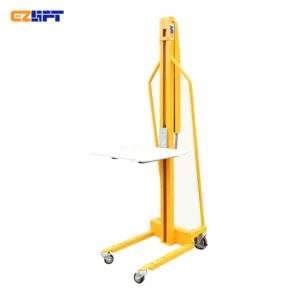
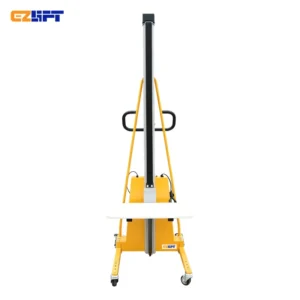
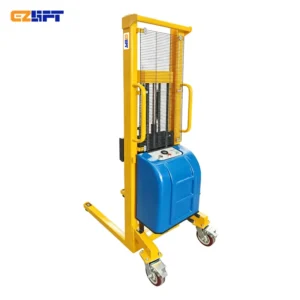
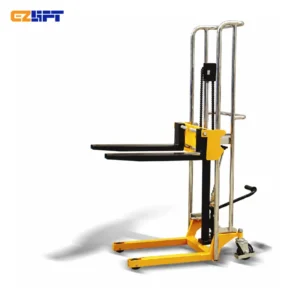
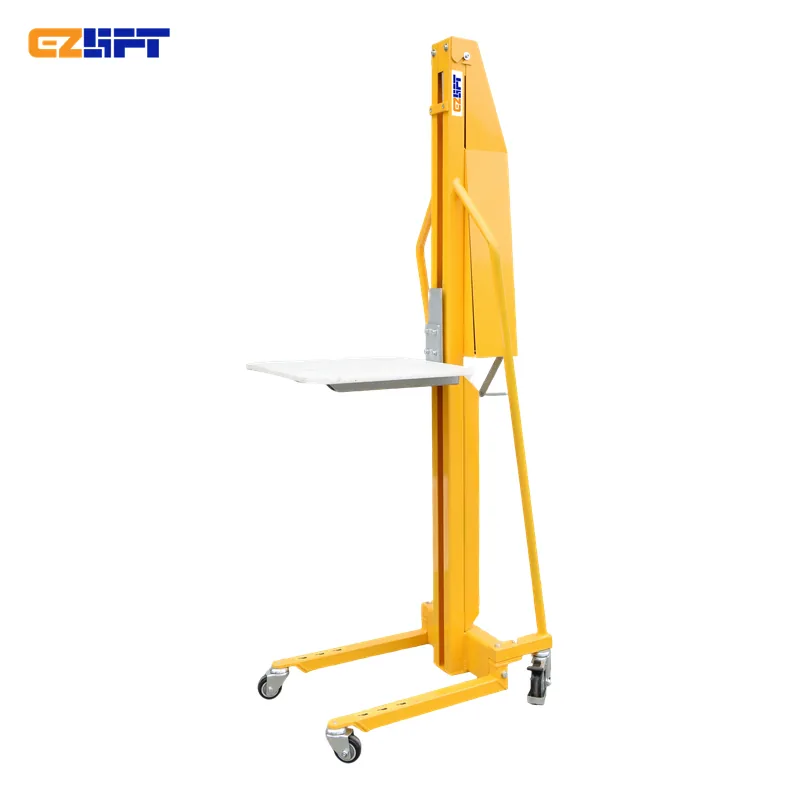
Mini Station Work Cart
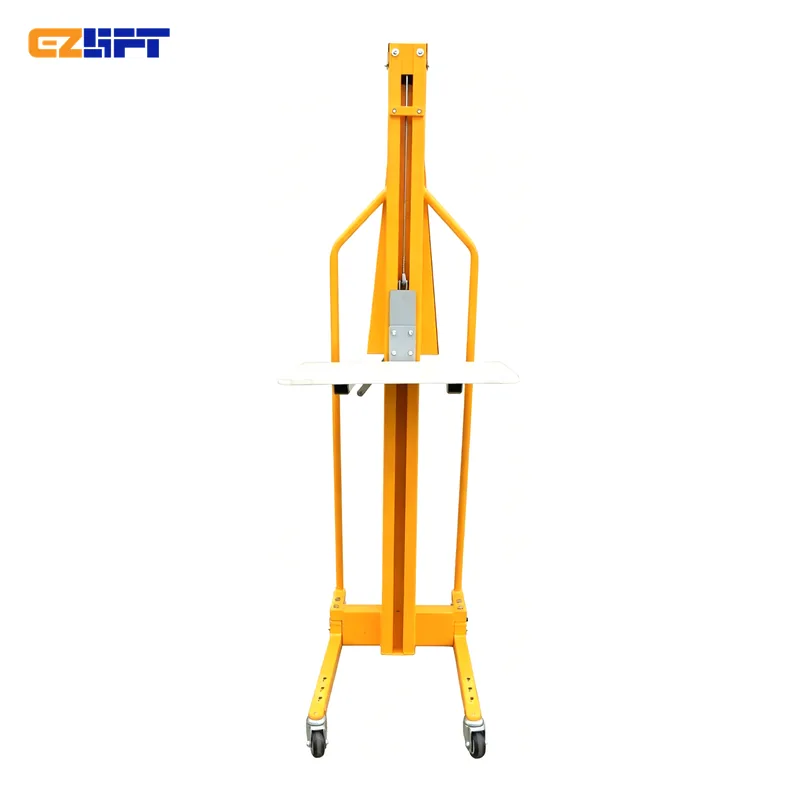
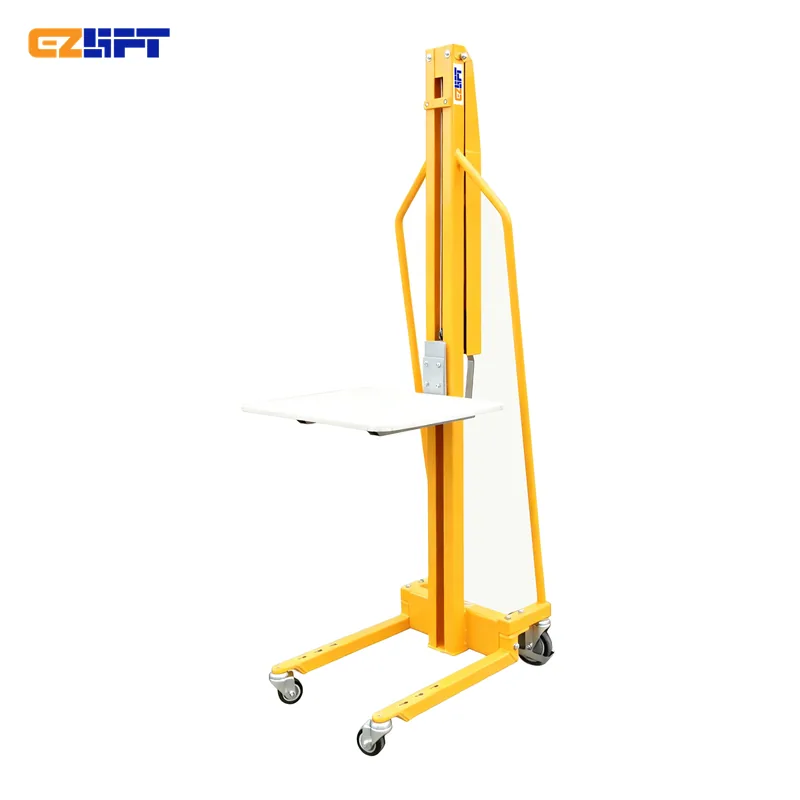
The Mini Station Work Cart is compact stack equipment designed for light-duty material lifting, workstation positioning and production line handling. With a flexible structure and easy manual operation, it helps operators lift small parts, cartons, tools and work-in-process materials to a comfortable working height.
As practical stacker equipment for warehouse and workshop use, the M100 and M200 models are suitable for daily handling tasks where space is limited and frequent short-distance movement is required. The compact body, stable lifting structure and optional quick-change fixtures make this stacker machine a useful choice for assembly stations, packaging areas and warehouse material transfer.
Key Features
- Innovative and compact design for flexible operation in narrow working areas.
- Equipped with safety devices to help prevent sudden rapid descent caused by mechanical failure.
- Stable and reliable structure for workstation lifting, material positioning and light warehouse handling.
- Available in M100 and M200 models with rated load capacities of 100 kg and 200 kg.
- Maximum platform height reaches 1500 mm, suitable for production line feeding and ergonomic work positioning.
- Compliant with European EN1757 standards.
Optional Quick-Change Fixtures
This material stacker equipment can be matched with different optional fixtures according to the shape of the handled material. These attachments help expand the use of the Mini Station Work Cart in warehouses, workshops and packaging operations.
Mini Station Work Cart Specifications
| Product Model | Unit | M100 | M200 |
|---|---|---|---|
| Type | – | Manual | Manual |
| Rated Load Capacity | kg | 100 | 200 |
| Load Center | mm | 250 | 250 |
| Minimum Platform Height | mm | 130 | 130 |
| Maximum Platform Height | mm | 1500 | 1500 |
| Platform Dimension (L x W) | mm | 600 x 470 | 600 x 470 |
| Front Wheel Spec (PU Wheel) | mm | Ø75 x 30 | Ø75 x 30 |
| Rear Wheel Spec (PU Wheel) | mm | Ø125 x 40 | Ø125 x 40 |
| Hydraulic Station Power | kW | – | – |
| Battery Parameter | Ah/V | – | – |
| Minimum Turning Radius | mm | 850 | 850 |
| Overall Dimension (L x W x H) | mm | 840 x 600 x 1830 | 870 x 600 x 1920 |
| Net Weight | kg | 50 | 60 |
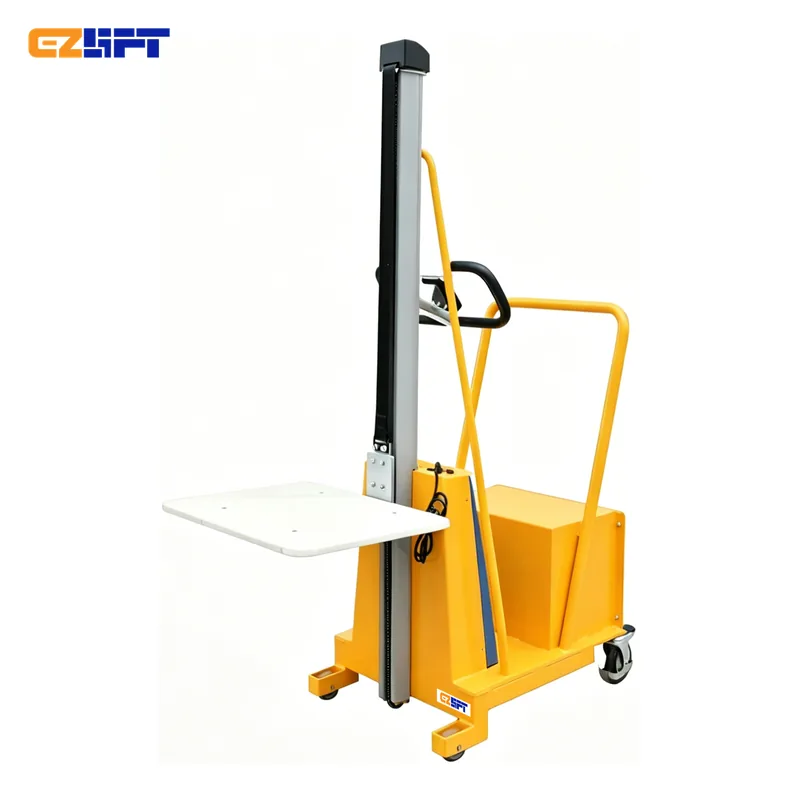
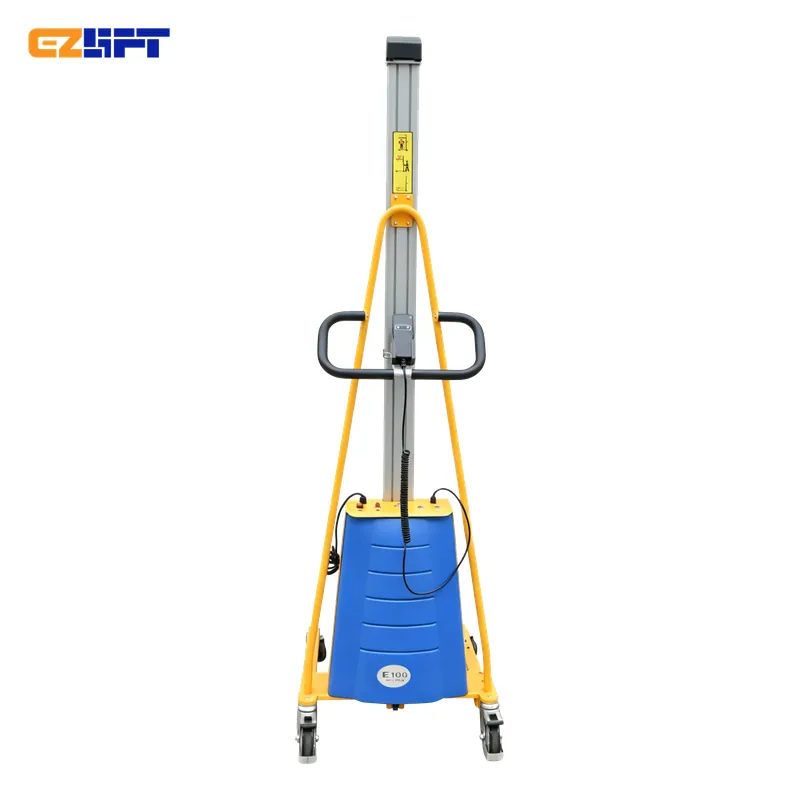
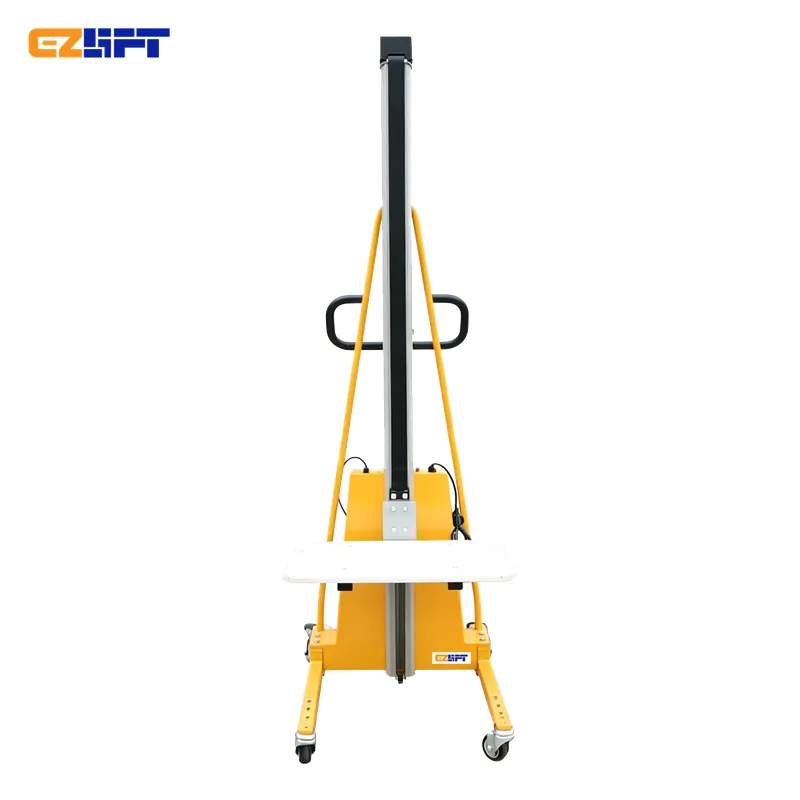
Mini Workstation Truck
The Mini Workstation Truck is compact electric stack equipment designed for light-duty lifting, material positioning and production line handling. With a lightweight structure and easy operation, it helps operators move small parts, cartons, tools and work-in-process materials more efficiently in warehouses, workshops and packing areas.
As practical stacker equipment for daily industrial handling, the E100, E150, E200 and E250 models offer rated load capacities from 100 kg to 250 kg. This stacker machine is suitable for frequent lifting tasks where manual handling is inefficient or physically demanding. Its electric lifting system helps reduce operator fatigue and improve workflow efficiency.
Key Features
- Sleek, lightweight and compact design for agile movement in limited working areas.
- Electric lifting operation for efficient material positioning and workstation handling.
- Built-in safety mechanisms help prevent sudden free fall in case of mechanical malfunction.
- Fitted with maintenance-free starter batteries to reduce maintenance time and expenses.
- Equipped with a battery level gauge and low-voltage warning light for safer operation.
- Fully compliant with European EN1757 standards.
Applications
This material stacker equipment is suitable for production line feeding, warehouse material handling, packaging workstations, assembly areas and light-duty lifting operations. It can be used as stacker warehouse equipment for transferring goods between storage areas, worktables, machines and packing stations.
Mini Workstation Truck Specifications
| Product Model | Unit | E100 | E150 | E200 | E250 |
|---|---|---|---|---|---|
| Type | – | Electric | Electric | Electric | Electric |
| Rated Load Capacity | kg | 100 | 150 | 200 | 250 |
| Load Center | mm | 250 | 250 | 250 | 235 |
| Minimum Fork Height | mm | 130 | 130 | 130 | 130 |
| Maximum Fork Height | mm | 1700 | 1500 | 1500 | 1700 |
| Platform Dimension (L x W) | mm | 600 x 470 | 600 x 470 | 600 x 470 | 600 x 470 |
| Front Wheel Spec (PU Wheel) | mm | 75 x 30 | 75 x 30 | 75 x 30 | 75 x 30 |
| Rear Wheel Spec (PU Wheel) | mm | 125 x 40 | 125 x 40 | 125 x 40 | 125 x 40 |
| Hydraulic Power Unit Power | kW | 0.8 | 0.8 | 0.8 | 0.8 |
| Battery Spec | Ah/V | 12/24 | 12/24 | 12/24 | 12/24 |
| Minimum Turning Radius | mm | 900 | 900 | 900 | 900 |
| Overall Dimension (L x W x H) | mm | 870 x 600 x 1990 | 870 x 600 x 1790 | 870 x 600 x 1790 | 900 x 600 x 2020 |
| Net Weight | kg | 66 | 63 | 63 | 90 |
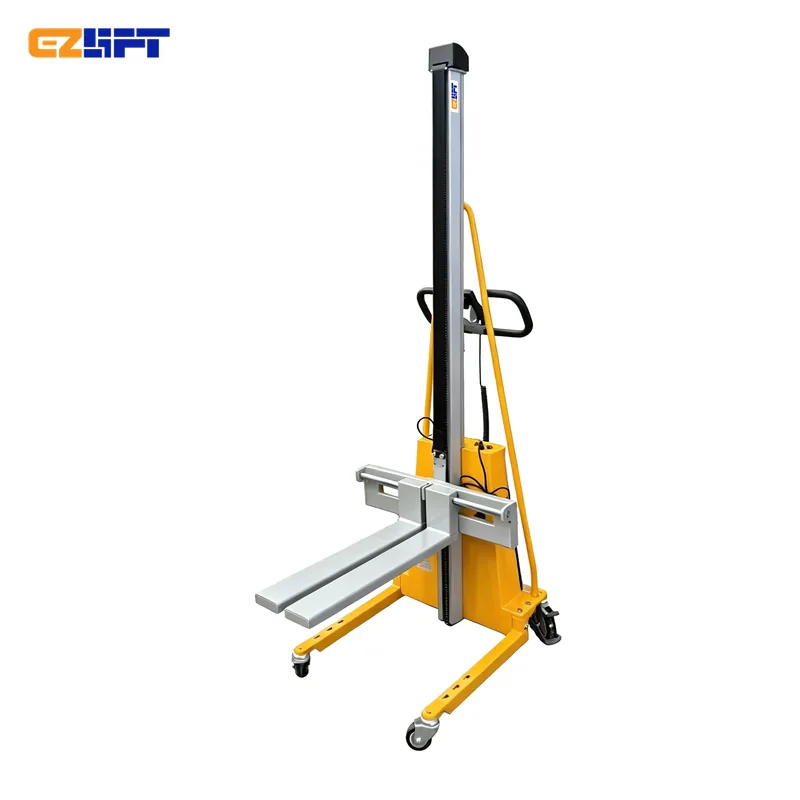
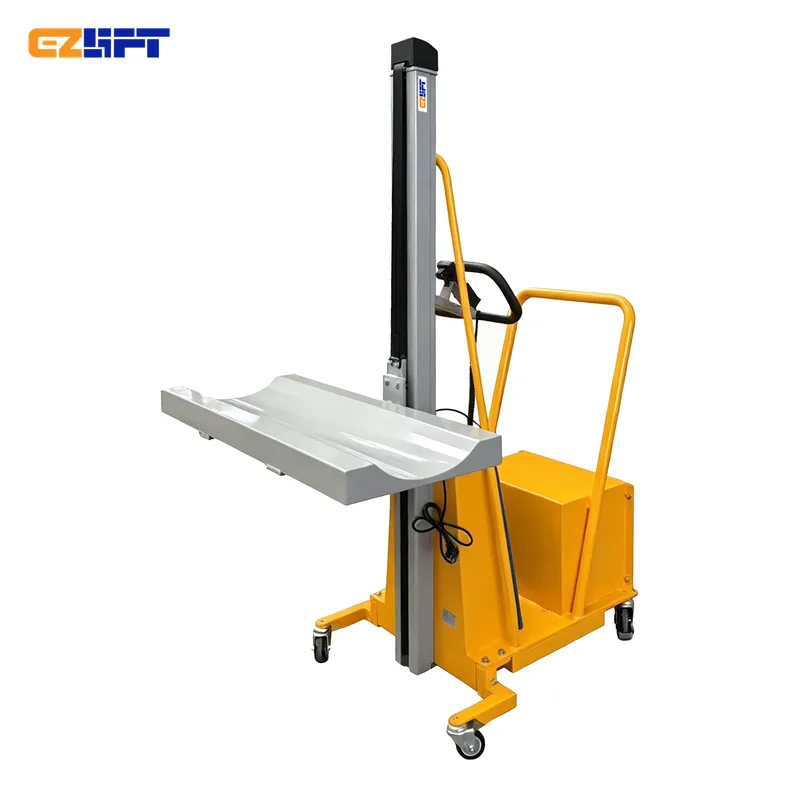
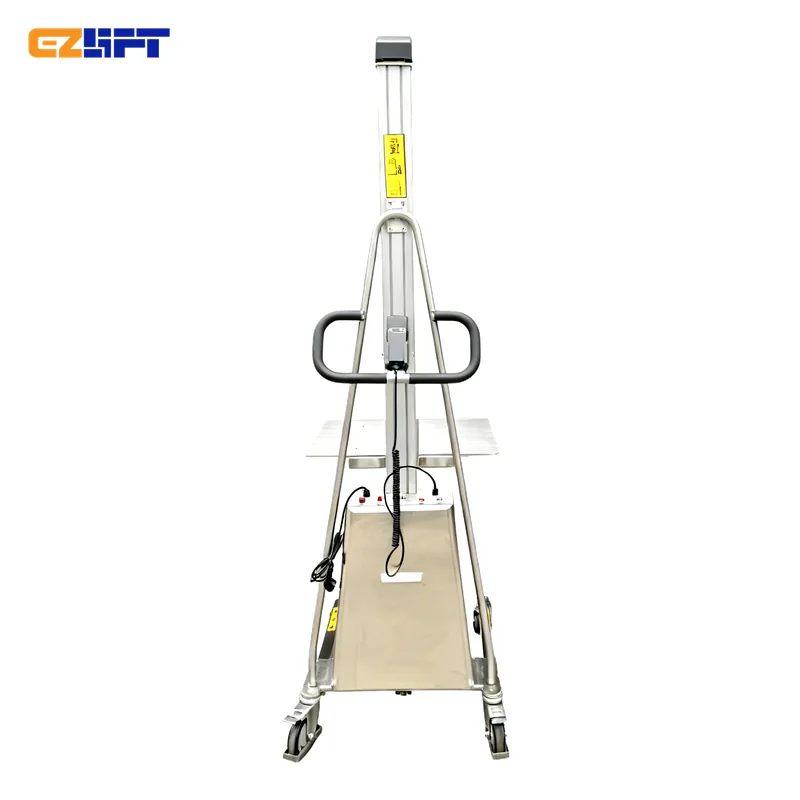
Mini Custom Non-standard Work Cart & Stainless Steel Work Cart
The Mini Custom Non-standard Work Cart is compact stack equipment designed for flexible workstation handling, light-duty lifting and customized material positioning. It is suitable for production lines, warehouses, packaging areas and workshops where operators need a small, easy-to-move stacker machine for daily handling tasks.
This material stacker equipment is available in standard and stainless steel designs. The stainless steel work cart is made of 304 stainless steel, making it suitable for clean, humid or corrosion-sensitive environments such as food processing, pharmaceutical production and clean workshop applications.
Key Features
- Novel and lightweight design with flexible operation.
- Built-in safety mechanisms help prevent unintended rapid descent.
- Equipped with VARTA maintenance-free batteries from Johnson Controls for long-lasting power supply.
- Includes a power indicator gauge and low-voltage warning light for safer daily operation.
- Available with customized platforms for different material handling requirements.
- Stainless steel model is made of 304 stainless steel for clean and corrosion-resistant working environments.
Applications
This custom stacker equipment can be used for production line feeding, workstation lifting, warehouse material transfer, packaging support and cleanroom handling. It is especially useful when standard stacker warehouse equipment cannot fully match the required load shape, platform size or working environment.
Specifications
| Product Model | Unit | E100S | E150S |
|---|---|---|---|
| Rated Load Capacity | kg | 100 | 150 |
| Load Center | mm | 235 | 235 |
| Minimum Fork Height | mm | 130 | 130 |
| Maximum Fork Height | mm | 1700 | 1500 |
| Platform Dimension (L x W) | mm | 600 x 470 | 600 x 470 |
| Front Wheel Spec (PU Wheel) | mm | 75 | 75 |
| Rear Wheel Spec (PU Wheel) | mm | 125 | 125 |
| Battery Specification | Ah/V | 12/24 | 12/24 |
| Overall Dimension (L x W x H) | mm | 850 x 600 x 1990 | 850 x 600 x 1790 |
| Net Weight | kg | 63 | 60 |
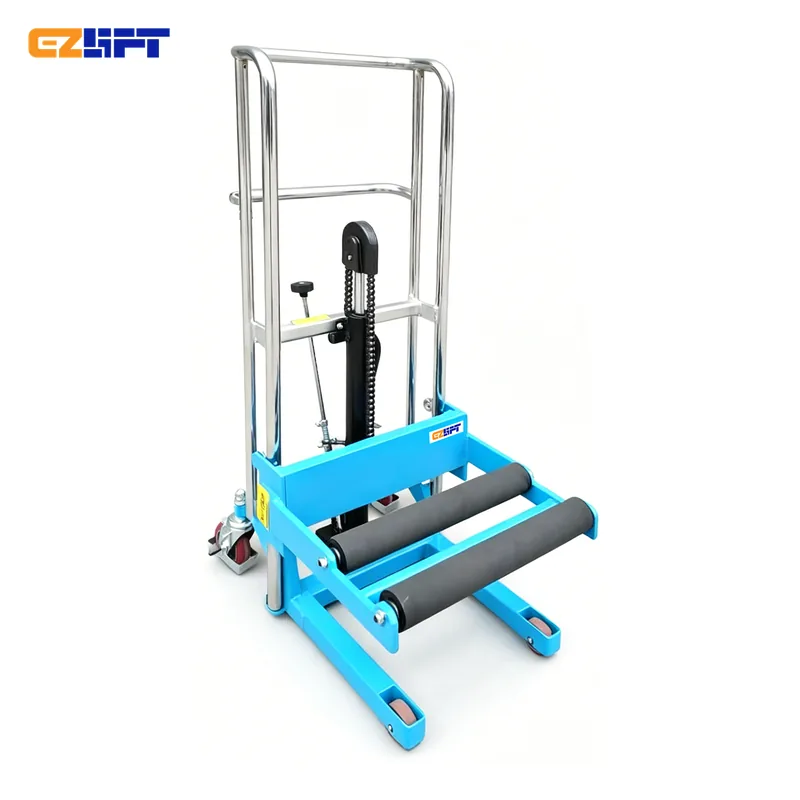
Round Roll Lifter
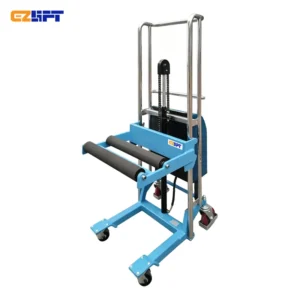
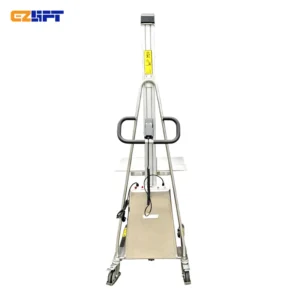
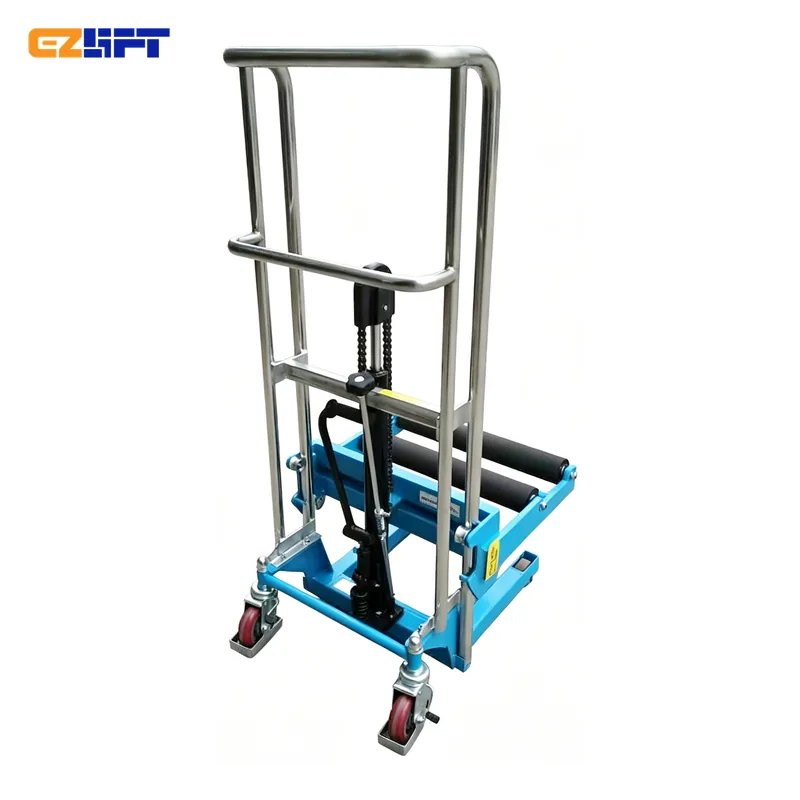
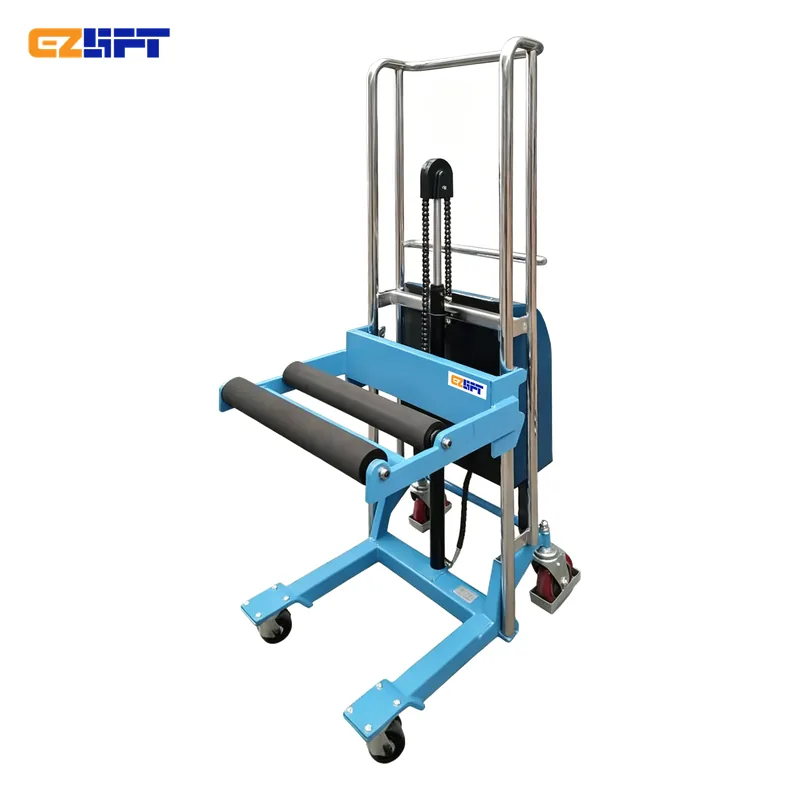
The Round Roll Lifter is specialized stack equipment for lifting, moving and positioning roll materials. It is suitable for paper rolls, film rolls, fabric rolls, packaging materials and other cylindrical loads. Compared with a flat platform stacker machine, the roller support structure provides better stability for round materials.
This material stacker equipment is available in manual hydraulic and semi-electric models. It is widely used in printing, packaging, textile, paper, film processing and warehouse handling applications where roll materials need to be transported or lifted to a suitable working height.
Manual Hydraulic Model
The manual hydraulic model uses a hydraulic pump and heavy-duty lifting chains installed in the middle section. Lifting is driven by hand crank or foot pedal hydraulic pump, while lowering is controlled by hydraulic pressure relief. It requires no external power supply, making it suitable for flexible operation in different working areas.
Semi-Electric Model
The semi-electric model is equipped with a battery control box and motor mounted on the side of the body. It supports electric button lifting with hydraulic assistance, helping reduce labor intensity and improve efficiency during frequent roll material handling.
Key Features
- Designed for paper rolls, film rolls, fabric rolls and other round materials.
- Available in manual hydraulic and semi-electric lifting options.
- Roller support structure helps hold cylindrical loads securely during handling.
- Suitable for roll diameters from 200 mm to 600 mm.
- Rated load capacity of 400 kg for medium-duty roll material handling.
- Compact stacker warehouse equipment for printing, packaging, textile and warehouse operations.
Round Roll Lifter Specifications
| Product Model | Unit | PF4120R | PF4150R |
|---|---|---|---|
| Rated Load Capacity | kg | 400 | 400 |
| Roller Lifting Height | mm | 1200 | 1500 |
| Minimum Roller Lowering Height | mm | 180 | 180 |
| Roller Dimension | mm | 76 x 550 | 76 x 550 |
| Roller Center Distance | mm | 180 | 180 |
| Applicable Coil Diameter | mm | 200-600 | 200-600 |
| Roller Material | – | Rubber / PU / Galvanized Steel / Stainless Steel Optional | Rubber / PU / Galvanized Steel / Stainless Steel Optional |
| Leg Height | mm | 80 | 80 |
| Overall Dimension (L x W) | mm | 780 x 630 | 780 x 630 |
| Overall Height | mm | 1420 | 1720 |
| Number of Foot Pump Strokes for Full Lift | times | 45 | 58 |
| Net Weight | kg | 78 | 85 |
Custom Stainless Steel Work Cart
Engineered for sanitary environments, this lifter features full food- and pharma-grade stainless steel construction. It resists harsh chemicals, frequent washdowns, and humidity, ensuring sterile, corrosion-free lifting inside cleanrooms, pharmaceutical labs, and food processing lines.
How to Choose the Right Stacker Machine
Selecting the right stacker machine keeps your facility safe, fast, and organized. We look at four core variables to match our material stacker equipment to your exact floor requirements.
| Selection Factor | Primary Consideration | Typical Range / Options |
|---|---|---|
| Load Capacity | Heaviest load + 20% safety margin | 100 kg to 1,500 kg |
| Lifting Height | Highest shelf beam + clearance | 1.2 m to 3.5 m |
| Drive / Lift Mode | Duty cycles per shift | Manual hydraulic vs. Semi-electric |
| Tooling Interface | Load shape and pallet profile | Adjustable forks, solid platform, reel core |
Choose by Load Capacity
Never size a unit at the absolute upper limit of your daily weights. We recommend matching the capacity of the stacker warehouse equipment to your maximum payload plus a safety buffer.
- Light Assembly (100 kg – 400 kg): Ideal for parts bins, hardware boxes, and small packaging lines.
- Medium Duty (400 kg – 800 kg): Suitable for dies, tooling, half-pallets, and intermediate bulk containers.
- Heavy Palletized Cargo (1,000 kg – 1,500 kg): Built for high-volume staging and warehouse racking.
Choose by Lifting Height
Measure both your target lift height and your overhead clearance:
- Top Beam Height: Ensure the extended mast lifts 150–200 mm above your top rack level for smooth loading.
- Collapsed Mast Height: Verify that the lowered stacker clears doorways, roll-up gates, and mezzanine crossbeams.
- Single vs. Double Mast: Use single-mast builds for low overhead spaces and two-stage telescoping masts for high-density warehouse stacking equipment setups.
Choose by Manual or Semi-Electric Operation
Daily cycle frequency determines whether manual or powered lifting makes economic sense.
- Manual Operation: For occasional lifts (10–20 cycles per day), a cost-effective manual hydraulic pallet stacker provides reliable service with zero charging downtime.
- Semi-Electric Operation: For multi-shift operations or high-frequency stacking, a semi-electric pallet stacker uses battery power to handle heavy lifting, eliminating operator fatigue while keeping manual push-pull positioning simple.
Choose by Fork, Platform or Roll Handling Type
Payload geometry dictates the working interface on the mast carriage:
- Adjustable Forks: Designed for Euro pallets, skids, and open-bottom crates. Width-adjustable carriages accommodate varying pallet entries.
- Flat Solid Platform: Drops directly over the forks or mounts as a dedicated deck. Best for loose components, chemical totes, and assembly line tool trays.
- Roll & Spindle Attachments: Replaces standard tines with a boom pole, V-cradle, or core mandrel to safely transport film rolls, paper reels, and cylindrical dies without rim damage.
Material Stacker Equipment for Different Applications
Every workspace demands a unique approach to lifting and positioning. We design our material stacker equipment to fit directly into your daily workflow, eliminating heavy physical strain and keeping operations moving without bottlenecks.
| Application Area | Primary Function | Ideal Stacker Feature |
|---|---|---|
| Warehouse Storage | Pallet/bin racking in narrow aisles | Compact chassis, tight turning radius |
| Production Lines | Infeed and component replenishment | Level-positioning, ergonomic lift tables |
| Roll & Coil Handling | Loading printing, textile, or film cores | Specialized roll prongs, boom attachments |
| Assembly Stations | Holding parts at ergonomic worker heights | Smooth platform lifters, custom fixtures |
Warehouse Material Handling
In high-density storage zones, conventional forklifts often struggle with tight clearances. Our warehouse stacking equipment operates effortlessly in confined aisles:
- Short-distance transport: Quickly shift boxes, totes, and smaller pallets between staging zones and storage racks.
- Vertical replenishment: Elevate inventory to secondary tiers without dedicating a full-sized counterbalanced truck to the task.
- Fleet optimization: Pairing targeted stack equipment with top forklift attachments that expand material handling allows you to cover every storage task efficiently across the floor.
Production Line Feeding
Keeping assembly lines stocked requires precision and constant uptime. A compact stacker machine delivers components directly to machine beds, CNC stations, or presses:
- Eliminates bending: Operators adjust height levels in real time to match feeder trays, preventing repetitive back fatigue.
- Continuous flow: Transport raw goods from staging bays straight into the fabrication cell with zero delays.
- Precise alignment: Smooth descent control allows gentle placement of sensitive parts directly onto production tables.
Roll Material Handling
Handling cylindrical items like paper rolls, plastic films, foil coils, and textiles requires specialized care to prevent surface damage and dropped loads:
- Core-locking and cradle options: Secure cylindrical goods through the central core or beneath the perimeter.
- Effortless loading: Align printing and converting machinery rollers with motorized lift adjustments.
- Damage reduction: Smooth gripping surfaces preserve costly packaging substrates during transport.
Packaging and Assembly Workstations
At packaging lines and sub-assembly benches, proper working height translates directly into speed and worker safety:
- Mobile work surfaces: Move assembled parts directly to the next process without manual offloading.
- Adjustable staging: Keep carton sealing and pallet stacking right at chest height as stacks grow taller.
- Cleanroom compatible: Stainless steel builds integrate seamlessly into sanitary food and pharmaceutical packaging areas.
Stacker Warehouse Equipment for Efficient Daily Operation
Keeping day-to-day warehouse workflows moving requires dependable machinery that eliminates handling bottlenecks. We build our stacker warehouse equipment to bridge the gap between heavy, high-maintenance forklifts and slow manual labor. Whether your floor team unloads delivery trucks, replenishes mezzanine racks, or shuttles inventory between staging bays, the right unit keeps operations running on schedule.
As a dedicated manual stacker manufacturer, we focus on rugged construction and operator-first ergonomics to maximize daily uptime:
- Tight-Space Maneuverability: Our compact chassis designs rotate smoothly within narrow storage aisles and congested sorting zones where standard forklifts cannot navigate.
- Rapid Pallet & Bin Placement: Responsive lifting controls let workers align forks or platforms precisely with shelf heights, cutting cycle times during peak picking hours.
- Reduced Physical Strain: Ergonomic tiller handles, foot guards, and polyurethane load wheels minimize pushing and pulling effort, reducing physical fatigue and workplace injuries.
- Low Maintenance Requirements: Simplified mechanical and hydraulic systems keep upkeep straightforward, so your warehouse stacking equipment spends its shift on the floor rather than in the repair shop.
Integrating specialized stack equipment into daily routines creates an organized, predictable workflow that keeps supply chains moving without unnecessary overhead costs.
Warehouse Stacking Equipment Specification Comparison
Selecting the right stacker equipment depends on matching exact physical requirements with daily operational duty cycles. We build each stacker machine with high-grade components to maintain stability, reduce operator fatigue, and fit tight aisle spaces.
The comparison table below details the technical specifications across our core lineup of material stacker equipment:
| Equipment Type | Rated Capacity | Max Lifting Height | Drive / Lift Method | Common Applications |
|---|---|---|---|---|
| Mini Station Work Cart | 100 – 150 kg | Up to 1,500 mm | Manual Foot Pump | Bench-height assembly, parts handling, small boxes |
| Mini Workstation Truck | 150 – 250 kg | Up to 1,600 mm | Manual / Electric Winch | Tight retail aisles, small tooling changes, office stock |
| Lightweight Manual Lifter | 200 – 400 kg | Up to 1,700 mm | Hand Winch or Foot Pump | Die loading, shelf placement, medium-duty staging |
| Lightweight Semi-Electric Stacker | 400 – 1,000 kg | Up to 3,000 mm | Manual Push / Electric Lift | Pallet racking, loading docks, high-frequency lifting |
| Round Roll Lifter | 150 – 350 kg | Up to 1,800 mm | Semi-Electric / Core Grip | Packaging film reels, paper coils, printing rolls |
| Stainless Steel Work Cart | 150 – 500 kg | Up to 2,000 mm | Manual or Semi-Electric | Pharmaceutical cleanrooms, food processing plants |
Key Specification Highlights
- Chassis Width and Turning Radius: Our compact warehouse stacking equipment maneuvers through narrow aisles as tight as 1,200 mm without sacrificing stability under full rated load.
- Mast Configurations: We utilize single-mast designs for maximum operator visibility on low-height carts, and reinforced dual masts on high-reach semi-electric models.
- Interchangeable Tooling: Platforms, standard forks, roll cradles, and drum grippers can be swapped onto a single chassis to adapt to seasonal inventory changes.
Every facility has unique workspace layouts and load profiles. We design and test our stacker warehouse equipment to withstand continuous industrial use. Discover more about our manufacturing standards and engineering capabilities to find the right configuration for your setup.
Why Choose EASY LIFT Stack Equipment
We build every piece of EASY LIFT stack equipment to solve real floor challenges: tight aisles, repetitive lifting injuries, and sluggish cycle times. When you invest in our material stacker equipment, you get durable machinery engineered to keep your team safe and your production moving without unnecessary complexity.
Core Advantages of Our Stacker Machines
- Ergonomic Design: Every stacker machine we build reduces physical strain, minimizing downtime and repetitive motion injuries.
- Compact Footprint: Our stacker warehouse equipment maneuvers smoothly through narrow storage racks, tight mezzanine doorways, and crowded assembly cells.
- Modular Customization: Swap forks, platforms, or specialized attachments to tailor your equipment to boxes, reels, or mixed inventory.
- Low Maintenance: Built with heavy-duty structural steel and sealed components, ensuring continuous duty cycles with minimal upkeep.
- System Integration: Our units work seamlessly alongside our specialized lifting solutions, such as mobile workshop cranes for industrial lifting, giving you complete facility-wide handling coverage.
EASY LIFT vs. Standard Market Alternatives
| Key Parameter | EASY LIFT Warehouse Stacking Equipment | Standard Market Lifters |
|---|---|---|
| Build Quality | Industrial-grade reinforced steel chassis | Thin-gauge sheet metal frames |
| Maneuverability | Smooth-glide castors with low rolling resistance | Heavy, sluggish wheel assemblies |
| Tooling Options | Quick-swap forks, platforms, and roll mandrels | Fixed setups with limited versatility |
| Safety Features | Overload protection, wheel locks, and fail-safe braking | Basic mechanical stops only |
| Operational Lifespan | Designed for multi-shift industrial workloads | Intended for light, occasional usage |
We focus on practical, dependable engineering that protects your operators and streamlines daily warehouse operations from day one.
FAQ About Stack Equipment
What is the difference between a manual and a semi-electric stacker machine?
A manual lifter relies on foot-pedal or hand-pump hydraulic power for lifting and manual pushing for travel. A semi-electric stacker machine uses a motorized drive for effortless vertical lifting while retaining manual transport. We recommend semi-electric models for higher cycle frequencies to eliminate operator strain, while manual units excel in low-duty, budget-conscious workspaces.
Can warehouse stacking equipment handle loads other than standard pallets?
Yes. Beyond standard forks for euro or open pallets, our material stacker equipment adapts to diverse production needs. We offer flat platforms for boxes, roll prongs for paper and film rolls, and clamp attachments for specialized tasks like handling drums using our hydraulic drum stacker systems.
How do I determine the right load capacity for stacker warehouse equipment?
Always calculate capacity based on your heaviest load plus a 15% to 20% safety margin. Pay close attention to the load center: as lift height increases, rated capacities can derate. Standard compact stackers handle between 150 kg to 400 kg effortlessly across light-duty manufacturing lines.
What maintenance does compact stack equipment require?
Daily operation requires minimal upkeep: Weekly: Check hydraulic fluid levels and inspect wheels for debris. Monthly: Lubricate lift chains and mast channels. Battery care: For electric and semi-electric models, charge regularly and avoid running batteries completely flat.
Related Sources
- https://www.hovmand.com/en/products/mobile-lifters
- https://www.osha.gov/sites/default/files/publications/osha2236.pdf
- https://www.vestil.com/product.php?FID=516