
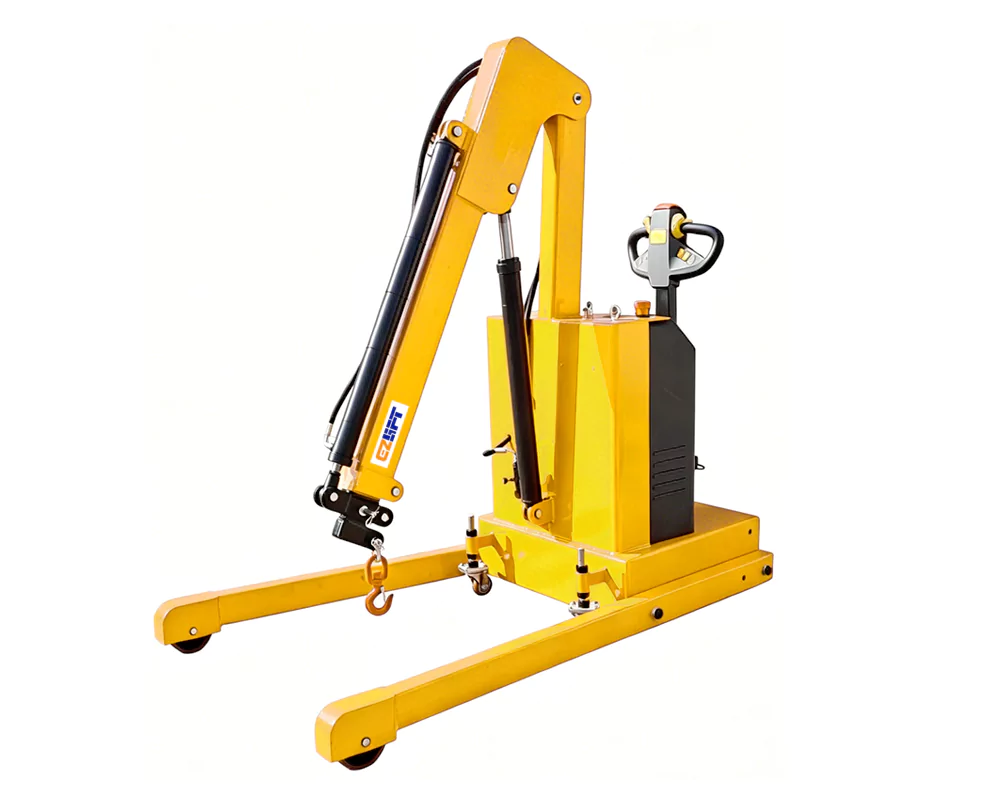
Mobile Workshop Cranes for Industrial Lifting
Mobile Workshop Cranes for Flexible Industrial Lifting Operations

Mobile Workshop Cranes: Flexible Lifting for Areas a Forklift Cannot Reach
Factories, maintenance departments and warehouses often need to lift motors, molds, machine components and heavy equipment in areas where a forklift cannot operate.
A mobile workshop crane combines a wheeled chassis, telescoping boom and hook lifting system in a compact machine. It can approach machinery from the front, reach over obstacles and position suspended loads with greater flexibility than a standard pallet-handling vehicle.
EASY LIFT offers semi-electric, electric-travel and all-electric mobile cranes for different lifting frequencies and operating environments.
Semi-Electric Single-Arm Crane
The semi-electric single-arm crane uses electric lifting and telescoping functions while travel is controlled manually. This configuration is suitable for applications where loads must be lifted frequently but moved only over relatively short distances.
Key features include:
- Electric lifting and boom extension
- Adjustable long-reach telescoping boom
- Wide lifting-angle range
- Manual travel for simple operation
- Foldable outriggers
- Compact folded size for storage and transport
Representative YLD01 specifications include:
| Specification | Value |
|---|---|
| Front wheel | 150 × 50 mm |
| Rear wheel | 150 × 50 mm |
| Battery | 12 V / 120 Ah |
| Hoisting motor | 1.6 kW |
| Turning radius | 1,750 mm |
| Folded dimensions | 1,100 × 800 × 1,900 mm |
| Self-weight | 466 kg |
This type of crane is suitable for maintenance departments, machine installation, assembly workshops and areas where a conventional forklift has insufficient access.
Electric Travel and Hydraulic Lifting Crane
The electric mobile crane combines electric travel with hydraulic lifting. Its boom length and lifting angle can be adjusted according to the required reach.
The catalog lists six representative boom positions:
| Boom position | A | B | C | D | E | F |
|---|---|---|---|---|---|---|
| Boom length | 1,440 mm | 2,300 mm | 2,500 mm | 2,700 mm | 2,900 mm | 3,100 mm |
| Capacity at 0° | 1,000 kg | 342 kg | 290 kg | 250 kg | 220 kg | 200 kg |
| Capacity at 40° | 1,100 kg | 565 kg | 430 kg | 345 kg | 290 kg | 250 kg |
The machine has an inner outrigger width of approximately 985 mm, an outer width of 1,170 mm and a net weight of approximately 568 kg. Its listed configuration includes a 12 V/120 Ah maintenance-free battery and 0.75 kW travel motor.
The table demonstrates an essential crane principle: lifting capacity changes with boom length and angle. The crane can handle its highest load close to the mast, while maximum reach is intended for lighter loads.
All-Electric Rotating Mini Crane
For higher operating frequency, an all-electric rotating mini crane integrates powered travel, electric or hydraulic lifting and powered boom adjustment.
Key functions include:
- Multi-function control handle
- Stepless travel-speed regulation
- Integrated hydraulic station
- Maintenance-free battery system
- Three-section telescoping boom
- Remote hook raising and lowering
- Approximately ±60° boom rotation
- Operator standing platform
- Electromagnetic braking
Representative performance data include:
| Specification | Value |
|---|---|
| Maximum rated load | 1,000 kg |
| Maximum boom length | Approximately 3,270 mm |
| Capacity at maximum reach | Approximately 300 kg |
| Maximum climbing ability | 5° |
| Turning radius | 2,150 mm |
| Drive motor | 1.2 kW |
| Lifting motor | 2.2 kW |
| Battery system | 24 V / 240 Ah |
| Net weight | Approximately 1,070 kg |
| Minimum overall dimensions | 2,200 × 1,100 × 2,155 mm |
The personnel-carrying pedal and electric travel system reduce the effort required when moving between workstations.
All-Electric Single-Boom Crane
The all-electric single-boom crane combines electric travel, hydraulic lifting, hydraulic forward movement and hydraulic boom extension.
Its counterweight chassis helps maintain stability while the heavy-duty hydraulic cylinder adjusts lifting distance. The design is suitable for machine assembly, mold installation and maintenance work where forklifts cannot approach the lifting point directly.
The listed YLH01 configuration includes:
- Self-weight of approximately 725 kg
- Approximately 600 kg counterweight
- Dual 12 V/120 Ah battery arrangement
- 2.2 kW hoisting motor
- 0.75 kW travel motor
- Travel speed of approximately 2 km/h
- Overall dimensions of approximately 2,200 × 1,015 × 1,950 mm
At different boom positions, rated capacity ranges from around 1,000 kg near the chassis to lower capacities at extended reach.
Product Advantages
Access to Restricted Areas
A long telescoping boom can reach over machinery, workbenches and production equipment where a forklift mast cannot enter.
Controlled Load Positioning
Hydraulic lifting and adjustable boom functions support gradual positioning during equipment installation or maintenance.
Compact Storage
Foldable outriggers and retractable booms reduce the machine’s storage and transportation dimensions.
Reduced Manual Effort
Electric lifting and travel systems reduce pushing, pulling and manual hoisting during frequent operations.
Multiple Power Configurations
Users can select manual-travel, electric-travel or fully powered models according to workload and budget.
Essential Safety Considerations
Before every lift, operators should verify the load weight, boom position and rated-capacity chart.
Both outriggers must be fully extended and in firm contact with the ground. Loads must never exceed the capacity shown for the actual boom length and angle. No person should stand beneath the suspended load or within the boom’s operating area.
The ground must be level and capable of supporting the crane, load and counterweight. Sudden travel, side pulling and lifting with an unsecured hook should be avoided.
Choosing the Right Mobile Crane
A semi-electric crane is suitable for occasional travel and frequent lifting. An electric-travel model is more appropriate for longer warehouse routes. All-electric rotating cranes are recommended for repeated lifting cycles, multiple workstations and applications requiring powered boom positioning.
By matching lifting capacity, reach, operating frequency and available aisle space, a mobile workshop crane can provide a flexible and cost-effective solution for industrial lifting tasks that cannot be completed efficiently with a conventional forklift.