
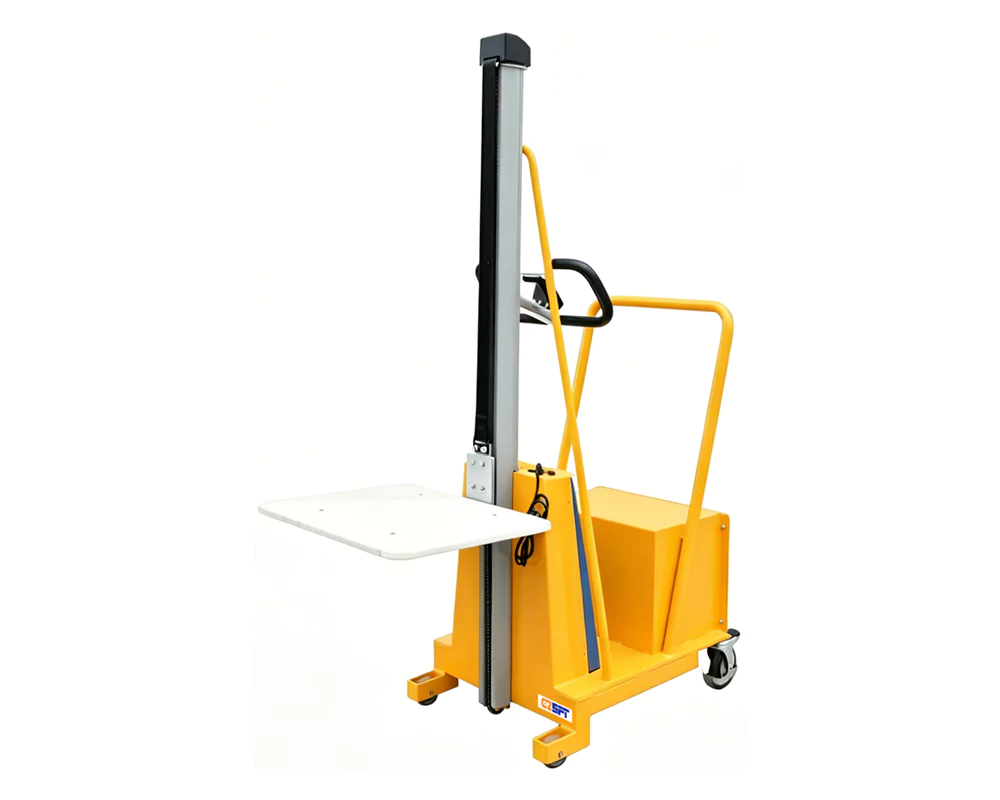
Mini Workstation Trucks for Material Handling
Mini Workstation Trucks for Efficient Material Lifting and Handling

Mini Workstation Trucks: A Compact Solution for Safer and More Efficient Material Handling
Modern warehouses, assembly lines and production workshops frequently need to lift components, tools, rolls and containers to a comfortable working height. Using forklifts for these small and repetitive tasks is often inefficient, while manual lifting can increase operator fatigue and workplace injury risks.
A mini workstation truck provides a practical alternative. Combining compact dimensions, precise lifting and flexible load platforms, it helps operators move and position materials safely in restricted industrial areas.
EASY LIFT offers both manual and electric workstation trucks for different load capacities and operating frequencies. The available range includes M100 and M200 manual models, as well as E100, E150, E200 and E250 electric models.
Compact Design for Restricted Work Areas
One of the main advantages of a mini workstation truck is its small footprint. Unlike conventional forklifts or large stackers, these units can operate beside production equipment, between shelves and inside narrow workshop aisles.
The M100 and M200 manual models have a turning radius of approximately 850 mm. The electric E-series models have a turning radius of around 900 mm. This compact geometry makes the equipment suitable for:
- Electronic and mechanical assembly lines
- Packaging and inspection stations
- Tool rooms and maintenance workshops
- Small warehouses and stockrooms
- Pharmaceutical and food-processing facilities
- Loading and positioning lightweight components
The equipment can be pushed manually to the required position, allowing workers to transport materials directly between storage, production and inspection areas.
Manual Workstation Truck Specifications
The M100 and M200 are designed for applications where lifting frequency is moderate and external power is not required.
| Specification | M100 | M200 |
|---|---|---|
| Operating type | Manual | Manual |
| Rated capacity | 100 kg | 200 kg |
| Load center | 250 mm | 250 mm |
| Minimum platform height | 130 mm | 130 mm |
| Maximum platform height | 1,500 mm | 1,500 mm |
| Platform size | 600 × 470 mm | 600 × 470 mm |
| Turning radius | 850 mm | 850 mm |
| Overall dimensions | 840 × 600 × 1,830 mm | 870 × 600 × 1,920 mm |
| Net weight | 50 kg | 60 kg |
Because no battery or external power supply is required, manual models are suitable for occasional lifting, maintenance work and locations where charging facilities are unavailable.
Electric Workstation Truck Specifications
The E-series uses an electric lifting system to reduce manual effort during frequent lifting cycles.
| Model | E100 | E150 | E200 | E250 |
|---|---|---|---|---|
| Rated capacity | 100 kg | 150 kg | 200 kg | 250 kg |
| Load center | 250 mm | 250 mm | 250 mm | 235 mm |
| Minimum fork height | 130 mm | 130 mm | 130 mm | 130 mm |
| Maximum fork height | 1,700 mm | 1,500 mm | 1,500 mm | 1,700 mm |
| Platform size | 600 × 470 mm | 600 × 470 mm | 600 × 470 mm | 600 × 470 mm |
| Hydraulic power | 0.8 kW | 0.8 kW | 0.8 kW | 0.8 kW |
| Turning radius | 900 mm | 900 mm | 900 mm | 900 mm |
| Net weight | 66 kg | 63 kg | 63 kg | 90 kg |
The E-series is equipped with a maintenance-free battery, battery-level display and low-voltage warning system. The catalog also lists built-in safety mechanisms intended to prevent sudden free fall in the event of a mechanical malfunction. Selected models are described as compliant with EN 1757 requirements.
Quick-Change Fixtures for Different Loads
A standard platform is not suitable for every material. For this reason, the workstation truck can be configured with different quick-change fixtures, including:
- Single-shaft supports for rolls and coils
- Dual-shaft fixtures for cylindrical components
- Drum rotating fixtures
- V-block supports for round workpieces
- Ball-bearing platforms for easier transfer
- Fork and customized platform configurations
This modular approach allows one lifting unit to support several production processes. A factory can change the fixture instead of purchasing a separate machine for every load type.
Key Product Advantages
Reduced Manual Handling
Electric lifting minimizes repeated bending, carrying and raising of heavy components. Materials can be positioned at a suitable ergonomic height for assembly, packing or inspection.
Precise Load Positioning
The vertical mast and controlled lifting system make it easier to align parts with machines, workbenches and production lines.
Low Maintenance Requirements
Maintenance-free battery configurations reduce routine battery servicing. The simple frame and wheel structure also make daily inspection straightforward.
Flexible Customization
Non-standard forks, stainless-steel bodies and customized platforms can be considered for special industries or load geometries.
How to Select the Right Model
Choose the model according to the heaviest expected load rather than the average load. The working attachment, load center and fixture weight should also be included in the calculation.
For occasional lifting below 200 kg, an M100 or M200 manual unit may be sufficient. For frequent production cycles, electric E100–E250 models can significantly reduce operator effort. Applications involving wet, hygienic or mildly corrosive environments may benefit from a stainless-steel configuration.
A properly selected mini workstation truck can improve productivity without requiring the operating space, fuel or maintenance associated with a conventional forklift.