
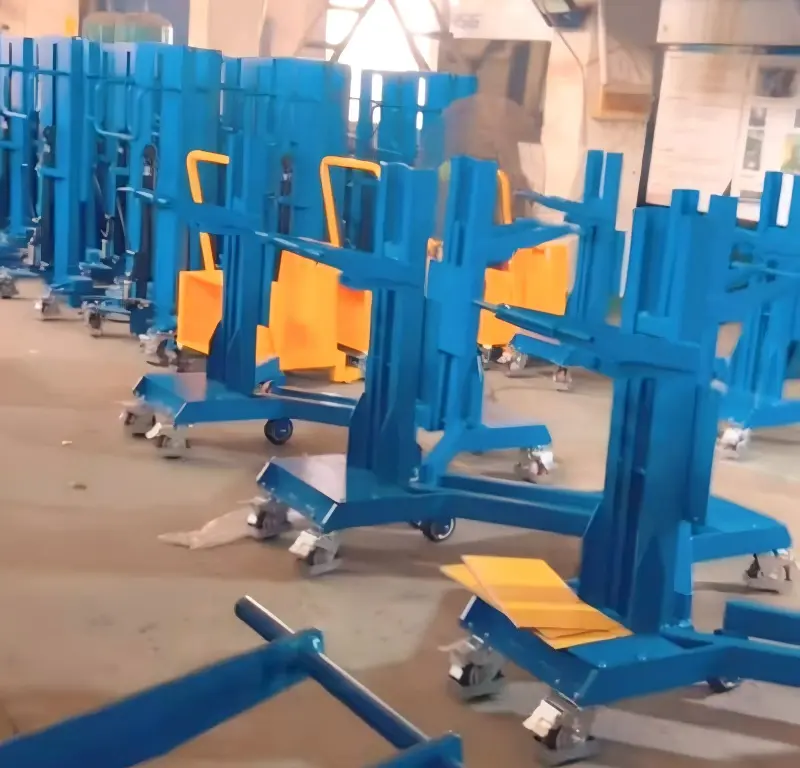
How to Choose Stacker Equipment for Warehouses
Learn how to choose stacker equipment by comparing load capacity lift height maneuverability safety features and warehouse handling needs

Struggling to choose the right stacker equipment for your warehouse?
Pick the wrong unit, and you face costly bottlenecks, wasted floor space, and dangerous safety hazards.
Pick the right one, and your material handling efficiency instantly skyrockets.
As someone who has spent years optimizing warehouse logistics, I know that your equipment choices directly impact your bottom line. In this guide, you’ll learn the exact, step-by-step framework to evaluate load capacity, lift heights, and facility layouts so you can select the best stacker equipment for your operations.
Let’s dive right in.
Understanding Warehouse Stackers and Their Importance
Modern warehousing demands fast cycle times, maximum vertical storage, and safe material flow. Stacker equipment serves as the vital bridge between standard hand pallet trucks and heavy counterbalance forklifts. Built for agility and vertical reach, this machinery keeps goods moving without requiring the massive turning radius or high operating budget of full-sized trucks.
What Is a Stacker in Material Handling?
A stacker machine is specialized material handling equipment designed to lift, move, and position palletized loads into vertical racking systems. Equipped with a rigid mast and support legs or outriggers, it safely elevates cargo beyond ground-level staging.
For facilities operating with narrow aisles or medium-intensity racking, this material stacker equipment provides the exact lifting capability needed without occupying valuable floor space.
| Equipment Type | Primary Function | Lift Height Range | Aisle Width Requirement |
|---|---|---|---|
| Pallet Jack | Horizontal transport | Floor level only (~200 mm) | Minimal (< 2.0 m) |
| Stacker Equipment | Transport & vertical lifting | 1.6 m – 5.5 m | Compact (2.0 m – 2.6 m) |
| Counterbalance Forklift | Heavy lifting & long hauls | 3.0 m – 7.0 m+ | Wide (> 3.5 m) |
Key Benefits of Using Stackers in Warehouses
Integrating dedicated stacker warehouse equipment directly impacts throughput, warehouse density, and operational safety.
- Maximizes Vertical Footprint: Allows facilities to exploit high-bay storage in narrow aisles where conventional forklifts cannot maneuver.
- Significantly Lower Capital Outlay: Delivers lift heights comparable to standard forklifts at a fraction of the purchase price and maintenance overhead.
- Intuitive Operation: Ergonomic controls require shorter training curves, enabling operators to handle loads safely and with pinpoint accuracy.
- Reduced Facility Wear: Compact frames and lighter gross weights lower the stress on warehouse floors and transition plates.
- Zero-Emission Clean Handling: Ideal for indoor food, pharmaceutical, and retail environments requiring quiet, fume-free operations.
Types of Stacker Equipment
Selecting the right stacker equipment comes down to how frequently you move loads, the weights you handle, and how far your operators must travel. Different warehouse layouts require different mechanical setups to maximize floor space and maintain throughput.
Manual Stackers
Manual stackers rely strictly on physical effort for both lifting and maneuvering. Operators use a hydraulic foot pump or hand lever to raise the forks and physically push or pull the unit across the floor.
- Best for: Low-frequency lifting, intermittent staging, and light assembly lines.
- Key advantage: Zero battery maintenance, lowest initial investment, and compact frames suited for tight spots.
- Limitation: Physically demanding on operators and limited to lower lift heights and lighter capacities.
Semi-Electric Stackers
A semi-electric setup balances affordability with physical relief. These units use a battery-powered hydraulic pump to lift and lower loads at the touch of a button, while travel remains manual. Investing in a durable semi-electric pallet stacker eliminates the strain of vertical lifting while keeping equipment footprints small. For lighter tasks, small-format options like our lightweight semi-electric stacker handle work cells, retail backrooms, and localized tooling setups efficiently.
- Best for: Small to medium warehouses, retail stockrooms, and medium-frequency stacking.
- Key advantage: Cuts lifting effort entirely without the price tag of a fully motorized drive system.
- Limitation: Pushing heavy pallets manually over long transit distances can slow down cycle times.
Fully Electric Walkie Stackers
Fully electric walkie stackers feature motorized drive wheels alongside electric lift systems. The operator controls travel speed, braking, and fork elevation from an ergonomic control handle while walking behind the unit. This material stacker equipment handles continuous daily cycles with minimal operator fatigue.
- Best for: Fast-paced distribution points, mid-sized storage facilities, and standard racking layouts.
- Key advantage: Smooth handling, automatic braking, and fast cycle times across long aisles.
- Limitation: Requires dedicated charging schedules and wider turning radii than purely manual units.
Ride-On and Reach Stackers
For high-density storage facilities and long-distance travel, ride-on and reach stackers provide industrial-grade capacity. Ride-on models feature foldable platforms or operator compartments, allowing workers to travel alongside the machine during long warehouse runs. Reach stackers integrate pantograph scissor mechanisms or moving masts, allowing the forks to extend directly into racking rows without moving the chassis legs under the pallet racking.
- Best for: High-bay storage, heavy industrial distribution centers, and double-deep racking setups.
- Key advantage: High lift elevations, maximum operator efficiency, and versatile rack access.
- Limitation: Higher acquisition cost and greater floor space required for maneuvering.
Key Factors to Consider When Choosing a Stacker
Selecting the right stacker equipment requires balancing your facility’s physical constraints with your daily payload demands. We build and configure every stacker machine to solve real-world floor challenges, ensuring your workflow stays fast, safe, and efficient.
| Key Consideration | Why It Matters | Practical Tip |
|---|---|---|
| Load Capacity | Prevents tipping and equipment wear | Always calculate capacity based on the load center, not just gross weight |
| Lift Height & Mast | Determines vertical reach and clearance | Check ceiling, door, and racking beam clearances before buying |
| Aisle Clearance | Dictates navigation and turning ability | Match the unit’s turning radius directly to your narrowest aisle width |
| Floor Surface | Influences wheel wear and traction | Pick wheel compounds (polyurethane vs. nylon) suited to your flooring |
Load Capacity Requirements
Load ratings are never one-size-fits-all. When sizing material stacker equipment, we always remind operators to account for the load center distance alongside total weight:
- De-rating at Height: Lifting a load higher reduces the actual capacity of your machine.
- Specialized Pallets & Containers: If your operation handles unusual loads like barrels, utilizing specialized drum handling equipment for safe lifting, tilting, and transport prevents uneven load distribution and keeps the center of gravity balanced.
- Safety Margins: Always select a unit that exceeds your heaviest standard load by at least 15% to avoid hydraulic strain.
Maximum Lift Height and Mast Types
Matching your stacker warehouse equipment to racking dimensions comes down to picking the right mast structure:
- Simplex (Single-Stage) Masts: Best for lower lift heights, mezzanine loading, and low-clearance tasks.
- Duplex (Two-Stage) Masts: Ideal for medium racking where overall collapsed height matters for passing through standard entryways.
- Triplex (Three-Stage) Masts: Designed for high-density warehousing with high vertical lift needs and full free-lift capabilities.
- Collapsed Height (OAH): Always measure your lowest doorway and overhead pipes to ensure the mast fits through when fully lowered.
Warehouse Aisle Width and Turning Radius
Navigating confined storage aisles requires precise footprint calculations. While standard counterbalance forklifts demand wide aisles of 11 to 13 feet, our compact stack equipment maneuvers easily in aisles as narrow as 6 to 8 feet. When mapping out floor layouts, review the outer turning radius ($Wa$) and add your standard pallet dimensions plus a 200 mm buffer to maintain smooth, collision-free turning circles. If your space uses different base designs, also consider how top forklift attachments that expand material handling interact with your unit’s overall operating radius.
Floor Conditions and Surface Compatibility
Stackers operate without dynamic suspension, which means the condition of your floor directly affects operational safety and wheel longevity:
- Smooth Concrete: Polyurethane wheels provide the best blend of low rolling resistance, silent operation, and high grip on finished surfaces.
- Uneven or Coarse Flooring: Cast nylon wheels withstand abrasive floors and chemical exposure, though they transmit more vibration.
- Ramps and Inclines: Keep an eye on undercarriage ground clearance and rated gradient performance; stackers with low chassis clearances can bottom out on steep ramp transitions.
Power Options and Operational Demands
Selecting the right power source for your stacker equipment directly impacts daily workflow, operational tempo, and overall productivity. Matching the machine’s drive and lift system to your facility’s daily volume prevents premature motor wear and eliminates mid-shift bottlenecks.
Manual vs. Electric Operation
The choice between manual and powered material stacker equipment comes down to frequency of use and physical load demands:
- Manual Stackers: Rely on hydraulic foot pedals or hand pumps. They are cost-effective, require virtually no electrical maintenance, and work well for low-frequency operations or smaller staging setups alongside mini workstation trucks for material handling.
- Semi-Electric Stackers: Combine manual travel with electric lifting, cutting down lift fatigue while remaining budget-friendly.
- Fully Electric Stackers: Feature powered travel and powered lift. These units are necessary for fast-paced facilities handling continuous stacking tasks over medium to long travel distances.
| Stacker Type | Best Application | Lift Mechanism | Propulsion | Maintenance Level |
|---|---|---|---|---|
| Manual | Occasional / Light staging | Manual Hydraulic | Manual Push/Pull | Low |
| Semi-Electric | Moderate lifting, short runs | Electric Motor | Manual Push/Pull | Moderate |
| Full Electric | High-throughput distribution | Electric Motor | Electric Drive Motor | Moderate to High |
Battery Types and Charging Times
The battery platform dictates how long your stacker machine stays on the floor:
- Lead-Acid Batteries: A proven, low-cost option. They typically require 8 hours to charge followed by an 8-hour cooling period. Regular maintenance—such as checking water levels and cleaning terminal corrosion—is mandatory to preserve battery lifespan.
- Lithium-Ion (Li-ion) Batteries: Deliver superior efficiency with rapid opportunity charging, reaching full capacity in 1 to 2 hours during scheduled breaks. They are completely maintenance-free, emit no gases during charging, and last up to three times longer than standard lead-acid packs.
Duty Cycles and Shift Requirements
Evaluating duty cycles ensures your stacker warehouse equipment matches your operational rhythm:
- Single-Shift Operations: Standard lead-acid or basic AGM battery packs are usually sufficient, charging overnight for the next business day.
- Multi-Shift Operations: Require either quick-swap battery compartments or fast-charging lithium-ion systems that can handle back-to-back 8-hour shifts without power loss.
- Intermittent Duty: For light storage rooms where the machine runs fewer than two hours a day, a semi-electric or manual unit easily meets operational demands without continuous charging management.
Safety, Ergonomics, and Usability
Worker safety and daily comfort determine the true efficiency of any facility. When we build and configure modern stacker equipment, our focus remains squarely on minimizing operator fatigue while eliminating workplace hazards.
Operator Controls and Ergonomics
Repetitive strain ruins productivity and leads to avoidable injuries. That is why our tiller handles and control heads feature ambidextrous layouts, letting operators lift, lower, and maneuver without shifting their grip.
- Intuitive Tiller Heads: Large butterfly switches and soft-touch buttons ensure effortless speed and lift control.
- Low-Effort Steering: Electric power steering options dramatically reduce the physical effort needed to pivot in narrow bays.
- Fatigue Reduction: Neutral-posture grips keep wrists and shoulders relaxed during heavy handling cycles.
Our core philosophy about us is rooted in building equipment that works seamlessly with the human body, keeping your team productive right up to the end of the shift.
Stability, Braking, and Speed Regulation
Operating a heavy stacker machine requires rock-solid stability, especially when loads are raised at maximum mast extensions. Modern units rely on integrated intelligent control systems to stabilize movement automatically:
- Electromagnetic Braking: Instant, fail-safe stopping engagement whenever the control handle is fully raised or lowered.
- Automatic Speed Reduction: Drive speeds automatically decelerate as the mast raises, preventing top-heavy tip-overs.
- Anti-Rollback Systems: Ensures safe stops and smooth starts on ramps and dock levelers without rolling backward.
- Belly Button Reverse Switch: An emergency button on the tiller head immediately reverses machine direction if it contacts the operator.
Visibility and Overhead Guarding
Clear sightlines are vital when positioning pallets inside high racking. High-performance material stacker equipment utilizes wide-view mast channels and nested lift cylinders, giving operators an unobstructed view of the fork tips.
For high-lift and ride-on units, sturdy overhead guards shield operators from falling items without compromising line-of-sight. High-impact polycarbonate shields protect hands and faces at the mast face while keeping daily operations fast, safe, and fluid.
Total Cost of Ownership and Maintenance
When we invest in stacker equipment, looking only at the purchase price tag leads to costly mistakes. The true cost of owning any material handling unit surfaces over months and years of daily warehouse cycles. Evaluating lifespan value, upkeep demands, and factory-backed support helps us protect our operating margins and keep our workflows uninterrupted.
Initial Acquisition Costs vs. Long-Term Value
Upfront pricing gives an incomplete picture. An entry-level manual unit requires low upfront capital, while a powered stacker machine commands a higher purchase price but unlocks faster cycle times and reduces physical strain on operators.
| Expense Category | Budget-Tier Stackers | Heavy-Duty Stacker Equipment |
|---|---|---|
| Initial Purchase | Low upfront investment | Moderate to high investment |
| Cycle Productivity | Best for intermittent, low-volume lifting | High-speed, high-density throughput |
| Labor Energy & Time | Higher physical effort, slower runs | Minimal operator strain, quick staging |
| Expected Service Life | 3 to 5 years under light use | 7 to 10+ years under managed care |
Choosing reliable machinery from a dedicated manual stacker manufacturer ensures baseline investments yield high mechanical returns without early failure rates.
Routine Maintenance and Parts Availability
Preventive maintenance keeps our stacker warehouse equipment running at peak performance. Simple, scheduled check-ups stop small mechanical issues from turning into costly warehouse downtime:
- Hydraulic Fluid Inspections: Monitor fluid levels monthly and inspect seals to prevent pressure drops.
- Mast Lubrication: Grease the mast channels and lifting chains regularly to stop metal-on-metal friction.
- Wheel and Caster Care: Remove wrapped shrink wrap or strapping from steer wheels to protect bearings.
- Battery and Electrical Checks: For powered units, inspect terminals for corrosion and monitor charge retention cycles.
Fast access to standardized wear parts—such as rollers, contactors, and seal kits—ensures our operations stay on schedule without waiting weeks for replacement components.
Manufacturer Warranty and Service Support
A solid warranty reflects genuine manufacturing quality. When sourcing material stacker equipment, we look for transparent warranty policies that separate structural steel coverage from electrical and hydraulic components.
- Structural Mast & Chassis: Should carry extended multi-year protection against welding cracks or frame fatigue.
- Pumps & Motors: Look for dedicated 1- to 2-year factory guarantees.
- Direct Technical Support: Access to factory technical manuals, schematics, and responsive support specialists ensures quick field repairs and dependable long-term operation.