
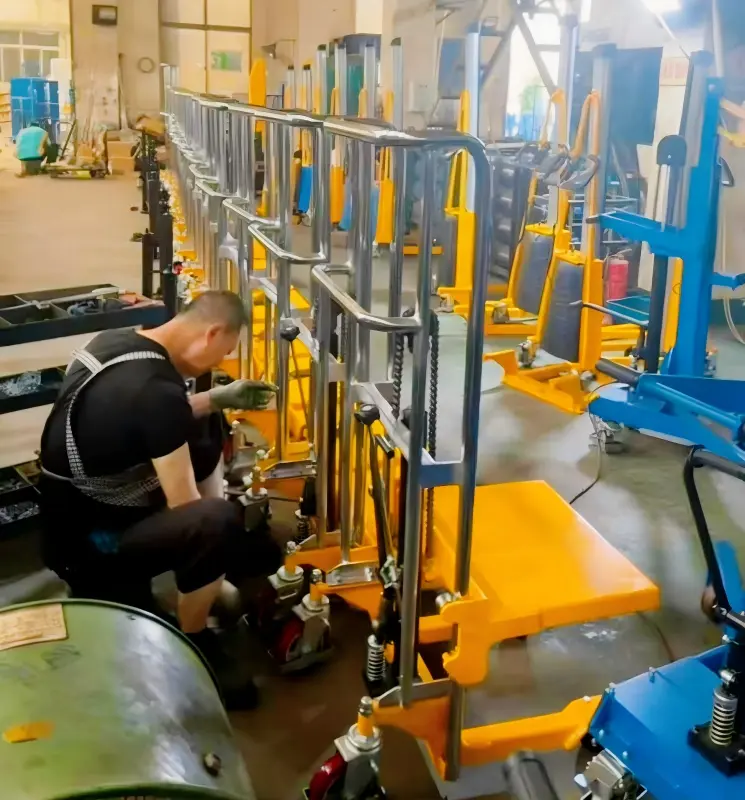
Semi Electric Straddle Stacker Guide for Warehouses
Explore semi electric straddle stacker features uses and selection tips for efficient warehouse pallet handling and storage operations

Understanding Semi Electric Straddle Stackers
What Is a Semi Electric Straddle Stacker?
A semi electric straddle stacker combines motorized hydraulic lifting with manual push-pull movement. This hybrid design delivers reliable lifting power for pallets while keeping equipment costs low. The defining feature is its straddle leg base, which wraps around the outside of a pallet so forks can lower completely to floor level.
Key characteristics include:
Electric Lifting: A dedicated battery-powered hydraulic motor raises and lowers heavy cargo with simple push-button controls.
Manual Navigation: The operator manually guides, steers, and pushes the unit, eliminating complicated electronic drive systems.
Straddle Base Legs: Outrigger legs positioned wider than the forks provide steady lateral stability without requiring a heavy counterweight.
Semi Electric vs. Manual vs. Fully Electric Stackers
Choosing the right stacker equipment depends on workload intensity, floor conditions, and budget requirements:
| Stacker Type | Lift Mechanism | Drive Mechanism | Ideal Application | Cost Profile |
|---|---|---|---|---|
| Fully Manual | Hand pump / Foot pedal | Manual push/pull | Intermittent, low-volume lifting | Lowest initial cost |
| Semi Electric | Electric hydraulic motor | Manual push/pull | Medium-duty, routine racking & staging | Economical balance of speed & cost |
| Fully Electric | Electric hydraulic motor | Motorized drive control | High-volume, continuous warehouse operations | Premium investment |
A semi electric stacker eliminates the intense physical strain of pumping manual hydraulics, allowing crews to move loads quickly into position without the capital investment required for fully powered drive units.
Core Components and Operating Mechanism
Every semi electric pallet stacker utilizes a durable mechanical and electrical system designed for daily reliability:
- Hydraulic Lift Assembly: Powered by a direct-current motor and hydraulic pump, providing smooth, consistent vertical motion with zero physical pumping.
- Mast and Lift Chains: Heavy-duty steel mast channels fitted with industrial leaf chains securely support fork movement under full load capacity.
- Adjustable Forks and Straddle Legs: The forks adjust horizontally along the carriage to match various pallet sizes, while the straddle legs distribute total weight across wide-set floor points.
- Integrated Battery and Charger System: An onboard deep-cycle industrial battery powers the hydraulics and charges via standard electrical outlets.
- Ergonomic Steering Handle: Designed with built-in lift/lower switches, dual steering handles, and protective hand guards for secure maneuvering.
- Mechanical Parking Brake: Floor locks and foot brakes secure the chassis in place before operators engage the lifting controls.
Key Benefits for Warehouses and Pallet Handling
Investing in our semi electric straddle stacker units bridges the gap between labor-intensive hand pumps and high-maintenance, full-sized forklifts. We design this stacker equipment to streamline daily operations in high-density storage spaces without inflating your capital expenses.
| Feature | Manual Stacker | Semi Electric Straddle Stacker | Full Electric Forklift |
|---|---|---|---|
| Initial Investment | Lowest | Budget-friendly | High |
| Lifting Mechanism | Manual hydraulic pump | Push-button electric motor | Powered hydraulic |
| Aisle Clearance | Tight | Narrow | Wide required |
| Maintenance Needs | Low | Low to moderate | High |
Cost-Effective Material Handling Solution
Our semi electric stacker delivers immediate cost savings for facilities that need reliable lifting without the overhead of heavy machinery:
- Lower Upfront Acquisition: You get mechanized lifting power at a fraction of the price of an electric reach truck.
- Minimal Maintenance: Without a drive motor or complex electronics, long-term servicing remains simple and affordable.
- Energy Efficiency: The onboard battery powers only the hydraulic lift pump, maximizing run time per charge cycle.
Enhanced Maneuverability in Narrow Aisles
Floor space is valuable, and wide aisles waste square footage. We engineer our semi electric pallet stacker line with a compact chassis and tight turning radius to thrive where standard forklifts cannot navigate:
- Compact Footprint: Easily steer through 7- to 8-foot aisles, staging areas, and cramped loading docks.
- Direct Control: The balanced frame and smooth-rolling casters let operators guide heavy loads precisely into place.
- Versatile Straddle Stance: Straddle legs wrap around standard pallets, keeping the overall machine length short and nimble.
Improved Ergonomics and Operator Safety
Manual lifting causes muscle strain, back injuries, and operator fatigue. Automating the vertical lift cycle creates a safer work environment and keeps your team productive through every shift:
- Push-Button Lifting: Operators raise and lower thousands of pounds effortlessly using simple handle-mounted controls.
- Mechanical Stability: Integrated floor locks, foot brakes, and a low center of gravity keep the chassis planted during vertical cycles.
- Clear Sightlines: The open-mast layout and transparent safety screens protect operators from debris while maintaining clear views of the racking.
Pallet Compatibility and Straddle Leg Design
When running a busy warehouse, pallet dimensions dictate equipment choice. Standard fork-over stackers trap you into using open-bottom skids only. A semi electric straddle stacker solves this limitation entirely. By positioning the support outriggers outside the load zone, our design provides true versatility across varied loading docks, staging floors, and racking rows.
Handling Closed-Bottom vs. Open-Bottom (Euro) Pallets
A standard 48×40-inch GMA pallet often features bottom deck boards that block traditional stacker outriggers from entering underneath. Attempting to lift bottom-board pallets with regular forks snaps the wood and drops the load. A semi electric pallet stacker built with straddle legs straddles the outside perimeter of the pallet, letting the lifting forks slide cleanly through the center stringers.
- Closed-Bottom / GMA Pallets: Handled effortlessly because the base legs stay completely on the outside of the pallet base.
- Open-Bottom / Euro Pallets: Equally compatible, eliminating the need to separate fleets for different pallet standards.
- Double-Faced Skids: Lifts full-perimeter skids without tearing bottom slats or damaging goods.
Adjustable Straddle Legs vs. Fixed Base Legs
I always recommend adjustable legs over fixed designs for standard commercial facilities. Warehouse operations rarely handle one uniform pallet dimension across every vendor shipment.
| Feature | Adjustable Straddle Legs | Fixed Base Legs |
|---|---|---|
| Inside Leg Width | Typically adjusts from 38″ to 50″ | Set at a single width (e.g., 42″) |
| Pallet Flexibility | Accommodates standard GMA, Euro, and custom crates | Limited strictly to loads narrower than inside width |
| Racking Compatibility | Tuned to fit snugly between pallet rack uprights | Requires fixed bay dimensions to clear floor uprights |
Adjusting the base width on our semi electric stacker hardware takes only standard shop tools. Once set, the wide stance lowers the center of gravity, maintaining rigidity when moving heavier units across flat concrete floors.
Weight Capacity and Maximum Lifting Heights
Lifting safely is about matching capacity to mast height. Every piece of stacker equipment features a rated lifting limit that balances pump output against structural leverage:
- Rated Lift Capacity: Models typically support 2,200 lbs to 3,300 lbs (1,000 kg to 1,500 kg) at a standard 24-inch load center.
- Maximum Lift Reach: Heights range from 63 inches (single mast) up to 138–140 inches (two-stage mast) for two-tier and three-tier racking.
- Deration at Height: Top-tier lifts require operators to factor in standard deration, ensuring high-positioned loads stay stable within rated overhead margins.
How to Choose the Right Stacker for Your Facility
Selecting the right semi electric straddle stacker comes down to matching your facility layout with your daily workload. Because you handle the travel manually while the machine powers the lift, evaluating your space constraints, ceiling limits, and operational pace upfront ensures your team stays productive without running into clearance issues.
Assessing Aisle Width and Turning Radius
Before investing in new stacker equipment, take accurate measurements of your narrowest aisles and staging areas. Manual steering requires enough clearance for both the chassis and the operator’s walking path.
- Clearance buffer: Always add at least 12 to 18 inches to the manufacturer’s minimum turning radius calculation to allow for comfortable operator movement.
- Pallet length impact: Standard 48×40-inch pallets extend past the front mast, widening the required turning arc.
- Straddle leg width: Ensure the outer width of the straddle legs clears your rack uprights and floor obstacles during sharp 90-degree turns.
Evaluating Mast Types: Single Mast vs. Two-Stage Mast
The mast configuration determines both your maximum lift reach and your ability to clear low doorways or mezzanine ceilings.
| Mast Type | Typical Lift Height Range | Collapsed Mast Profile | Best Facility Fit |
|---|---|---|---|
| Single Mast (Simplex) | Lower reach (up to 60–80 inches) | Lower overall height; no secondary stage extension | Facilities with low door frames, truck bed unloading, and single-tier staging |
| Two-Stage Mast (Duplex) | Higher reach (up to 118–138+ inches) | Taller collapsed height; extends upward via hydraulic telescoping | Standard pallet racking, multi-tier shelving, and high-density storage |
Choosing between them depends on your overhead clearance. If your facility has 8-foot garage doors or low-hanging lighting, confirm the collapsed mast height before committing to a tall two-stage semi electric stacker.
Battery Specifications, Duty Cycles, and Charging Requirements
The hydraulic lift motor on a semi electric pallet stacker depends on reliable battery power to handle full-capacity loads throughout a shift.
- Voltage and Capacity: Most units operate on heavy-duty 12V or 24V deep-cycle industrial batteries designed specifically for steady lifting cycles.
- Duty Cycle Planning: Semi-electric units work best for intermittent-to-moderate duty cycles. If your team performs non-stop lifting for 6 to 8 hours straight, plan for mid-day top-off charging or higher amp-hour battery packs.
- Charging Infrastructure: Most commercial units feature built-in chargers that plug directly into standard 110V wall outlets, eliminating the need for dedicated high-voltage charging stations. Keep charging areas ventilated, dry, and near your main staging zone for seamless overnight recharges.
Operation, Safety, and Maintenance Best Practices
Keeping a semi electric straddle stacker running reliably comes down to consistent daily habits and structured upkeep. Because this stacker equipment combines manual transit with powered hydraulic lifting, operators must stay mindful of both physical handling rules and electrical maintenance to protect inventory and crew members.
Pre-Shift Inspection and Daily Safety Checklist
Before putting any semi electric pallet stacker into service for the day, we mandate a quick visual and operational walkaround. Catching minor wear early avoids unplanned downtime during critical staging hours.
- Visual Frame and Mast Check: Inspect the mast rails, lifting chains, and straddle legs for signs of distortion, cracks, or loose hardware.
- Hydraulic System: Look beneath the chassis and around the lift cylinder for any traces of fluid leaks.
- Emergency Stop and Lift Controls: Power on the unit and test both the raise and lower pushbuttons, ensuring the emergency cut-off switch kills power instantly.
- Wheels and Braking: Verify that the steer casters pivot freely and that the manual foot brake locks firmly in place.
- Battery Gauge: Confirm the onboard indicator displays sufficient voltage before taking the unit into high-bay storage areas.
Safe Operating Guidelines for Racking and Stacking
Operating a semi electric straddle stacker requires distinct techniques to balance loads properly and prevent tip hazards:
- Travel Low: Always keep palletized loads lowered to a transit height of 4 to 6 inches from the floor while moving. Never pull or push the stacker across the warehouse with the forks elevated.
- Set the Brake Before Lifting: Position the straddle legs squarely around the pallet or rack upright, bring the machine to a complete stop, and depress the floor brake before activating the hydraulic lift.
- Respect Rated Load Centers: Center the load flush against the fork backrest. As lift heights increase, capacity ratings drop; never exceed the manufacturer chart displayed on the mast.
- Smooth Manual Navigation: Use controlled steps when pulling or maneuvering heavy loads, keeping clear sightlines around corners and away from pedestrian zones.
Routine Battery Care, Hydraulic Inspection, and Preventative Maintenance
Scheduled service keeps your semi electric stacker performing at peak capacity and extends its service life.
| Component | Service Frequency | Key Maintenance Action |
|---|---|---|
| Industrial Battery | Weekly | Recharge promptly after shifts; avoid deep discharges below 20%. Clean terminals to prevent corrosion buildup. |
| Hydraulic Fluid | Monthly / Quarterly | Check oil reservoir level with forks fully lowered. Replace hydraulic oil annually or whenever discoloration occurs. |
| Lift Chains | Monthly | Clean, lubricate with chain lube, and check for equal tension and stretch across both sides of the mast. |
| Straddle Wheels & Casters | Quarterly | Inspect polyurethane tread for flat spots or debris buildup; grease wheel bearings via grease fittings. |
Related Sources
- https://www.ccohs.ca/oshanswers/safety_haz/materials_handling/powered_trolleys.html
- https://www.toyotaforklift.com/resource-library/material-handling-solutions/understanding-walkie-stacker-types
- https://www.vestil.com/product.php?FID=575
- https://www.hyster.com/en-us/north-america/products/walkie-stackers/